While I probably won’t ever fit any Christian label perfectly, being a Jewish follower of Jesus, a biblical scholar, theologian, and author, I believe Eastern & Oriental Orthodoxy are the closest to the original view of the Gospel—back when it was still very Jewish.
Western Christianity, shaped by Augustine, sees sin as rebellion: a crime to be punished and crushed.
Eastern Christianity sees sin differently. Not as a crime, but as a disease to be healed. In this view, Yeshua did not come so that the Father could punish Him. He came to heal in the Father’s name. In the West, blood had to be shed because an angry God demanded blood. In the East, a loving God gives sick humanity a cosmic blood transfusion, rich with white blood cells (metaphorically speaking, of course). This is the God who introduced Himself to Israel in the wilderness with the words Ani Adonai rof’ekha: “I am the LORD, your Healer” (Exodus 15:26).
And that shapes the believer’s calling, too. In the East, the believer’s task is to heal, to repair, to do the Jewish work of tikkun olam. In the West, the believer’s task is to warn the world about an angry God who is about to burn us all forever.
If you ask me, as a Jew who follows Yeshua and holds a doctorate in Christian theology, the god of Western Christianity looks far more like Molech than like the God of Israel. And the irony is almost too much to bear. Ge Hinnom, the valley where children were burned alive as offerings to Molech, is the very place that gave “Gehenna,” hell, its name. And about what was done there, the God of Israel says through Jeremiah: “which I did not command, nor did it enter My heart” (Jeremiah 7:31).
What never entered the heart of God somehow entered the hearts of theologians.
Eastern Christianity is not perfect. But it stands far closer to the original. It is more faithful to Scripture, and it carries the authentically Jewish spirit of repairing the world. Western Christianity has given the world a great deal, both good and bad. I simply don’t believe it understands the gospel it is preaching.
So Christian groups within both the Eastern Orthodox (about 14 main groups) and Oriental Orthodox (about six main groups) traditions/denominations share a remarkably similar theological worldview—especially when compared with the vast spectrum of beliefs found in the Western churches (Roman Catholic, Protestant, Evangelical, etc.). Their shared theological views create a common foundation that stretches back to the earliest centuries of Christianity. Of course, the two traditions are not identical; they differ on several historical and theological points. Yet overall, their approach to faith, worship, and doctrine is far more alike than the many divergent streams that emerged in the West.
As Christianity moved Westward (to Rome), it absorbed the worldviews of Greek philosophy, Neoplatonism, and Gnostic speculation. The Eastern Orthodox tradition, on the other hand, remained both geographically and theologically the Christian tradition that most faithfully preserves the worldview, spirituality, and theological instincts of the earliest Jewish disciples.
When you compare Orthodoxy with the two major Western streams—Roman Catholicism (heavily reshaped by Augustine in the 4th century) and Protestantism (lightly reshaped again in the 16th century by Luther and Calvin)—you quickly notice how dramatically the Western Church drifted from the Hebraic mindset of Jesus and His apostles. Western theology became increasingly philosophical, juridical, abstract, and obsessed with legal categories: guilt, penalty, forensic righteousness, satisfaction, and the terrifying doctrine of Eternal Conscious Torment. These concepts were foreign to ancient Judaism and equally foreign to the early Church Fathers.
Orthodoxy, by contrast, maintained the older Jewish way of seeing the world: salvation not as escaping hell but as healing; sin not as a legal status but as a sickness; God not as a cosmic judge demanding satisfaction by killing or torturing others but as the Great Physician restoring His wounded creation. The early church fathers beloved in Orthodoxy—such as Ignatius of Antioch, St. Athanasius, St. Basil the Great, St. Gregory of Nyssa, and St. Isaac the Syrian—saw the Gospel as God’s relentless effort to save and restore humanity to wholeness universally, not as a divine courtroom drama requiring infinite punishment. Gregory of Nyssa, in particular, articulated a vision of apokatastasis—the ultimate restoration of all things—which resonates deeply with both Scripture and the worldview of Paul and the most early disciples of Jesus:
Romans 5:18–19:
“Therefore just as one man’s trespass led to condemnation for all, so one man’s act of righteousness leads to justification and life for all. For just as by the one man’s disobedience the many [all] were made sinners, so by the one man’s obedience the many [all] will be made righteous.”
1 Corinthians 15:21–22:
“For since death came through a human being, the resurrection of the dead has also come through a human being; for as all die in Adam, so all will be made alive in Christ.”
1 Corinthians 15:28:
“When all things are subjected to him, then the Son himself will also be subjected to the one who put all things in subjection under him, so that God may be all in all.”
Colossians 1:19–20:
“For in him all the fullness of God was pleased to dwell, and through him God was pleased to reconcile to himself all things, whether on earth or in heaven, by making peace through the blood of his cross.”
Lamentations 3:31-32:
“For no one is cast off by the Lord forever. Though he brings grief, he will show compassion, so great is his unfailing love.“
1 Timothy 4:10:
“The living God, who is the Savior of all people, and especially of those who believe.”
Romans 5:18:
“Therefore, as one trespass led to condemnation for all men, so one act of righteousness leads to justification and life for all men.”
1 John 2:1-2:
“If anybody does sin, we have an advocate with the Father—Jesus Christ, the Righteous One. He is the atoning sacrifice for our sins, and not only for ours but also for the sins of the whole world.”
Colossians 1:20:
“And through him to reconcile to himself all things, whether on earth or in heaven, making peace by the blood of his cross.”
Philippians 2:10:
“At the name of Jesus every knee should bow, in heaven and on earth and under the earth”
1 Timothy 2:3-6:
“God our Savior, who wants all people to be saved and to come to a knowledge of the truth. For there is one God and one mediator between God and mankind, the man Christ Jesus, who gave himself as a ransom for all people.”
John 12:47:
“Jesus did not come to judge the world but to save it.”
Acts 3:21:
“Heaven must receive him until the time comes for God to restore everything, as he promised long ago through his holy prophets.”
The Orthodox tradition has preserved these early universalist intuitions far more faithfully than the Western church. In the West, Augustine’s deeply pessimistic soteriology—with its man-made categories of original sin, inherited guilt, and a legal-transactional view of atonement—gradually overshadowed the hopeful, healing-centered theology of the first Christian centuries. Where the early Church proclaimed a God whose purpose was to restore all things, Western theology increasingly emphasized guilt, divine anger, and the narrow rescue of an elect few. Orthodox Christianity, by contrast, retained far more of the original vision: salvation as healing, judgment as purification, and God’s love as ultimately triumphant. Or in one Jewish term: Tikkun Olam (cosmic world restoration).
Even the Eastern liturgy itself reflects this continuity with ancient Judaism: the chanting of psalms, the cyclical calendar rooted in feasts rather than abstract doctrines, the emphasis on the incarnation as God dwelling among us (echoing the Shekinah presence), and the communal spirituality (rather than the individualistic “my relationship with God”) that mirrors the synagogue’s communal rhythms far more than Western individualism. The Orthodox calendar revolves around Passover fulfilled in Pascha, not Good Friday as a divine punishment event. The Divine Liturgy feels less like a Roman courtroom and more like a Jewish family table, a sacred meal where heaven and earth meet. Most importantly, the Orthodox understanding of the afterlife—fire as God’s purifying love experienced differently depending on one’s state—is much closer to the Jewish view of hell than to the Western medieval torturous imagination (Dante’s Inferno, etc.).
While I believe no tradition is perfect and no one denomination or one Christian group (there are 40,000 of them!) has it all figured out, Orthodoxy has preserved something essential: the Jewish-Christian soul of the Gospel. It kept alive the vision of salvation as transformation, not transaction; communion, not legal acquittal; restoration, not retribution. In many ways, the Orthodox Church stands as the closest living expression of what the earliest followers of Jesus believed—a faith centered not on fear of eternal torture but on the healing fire of divine love that ultimately makes “all things new.”
Indeed, Jesus didn’t die in a vacuum. His death was not random or isolated. It was the fulfillment of a story God had been telling for generations — a story rooted in the Hebrew Scriptures.
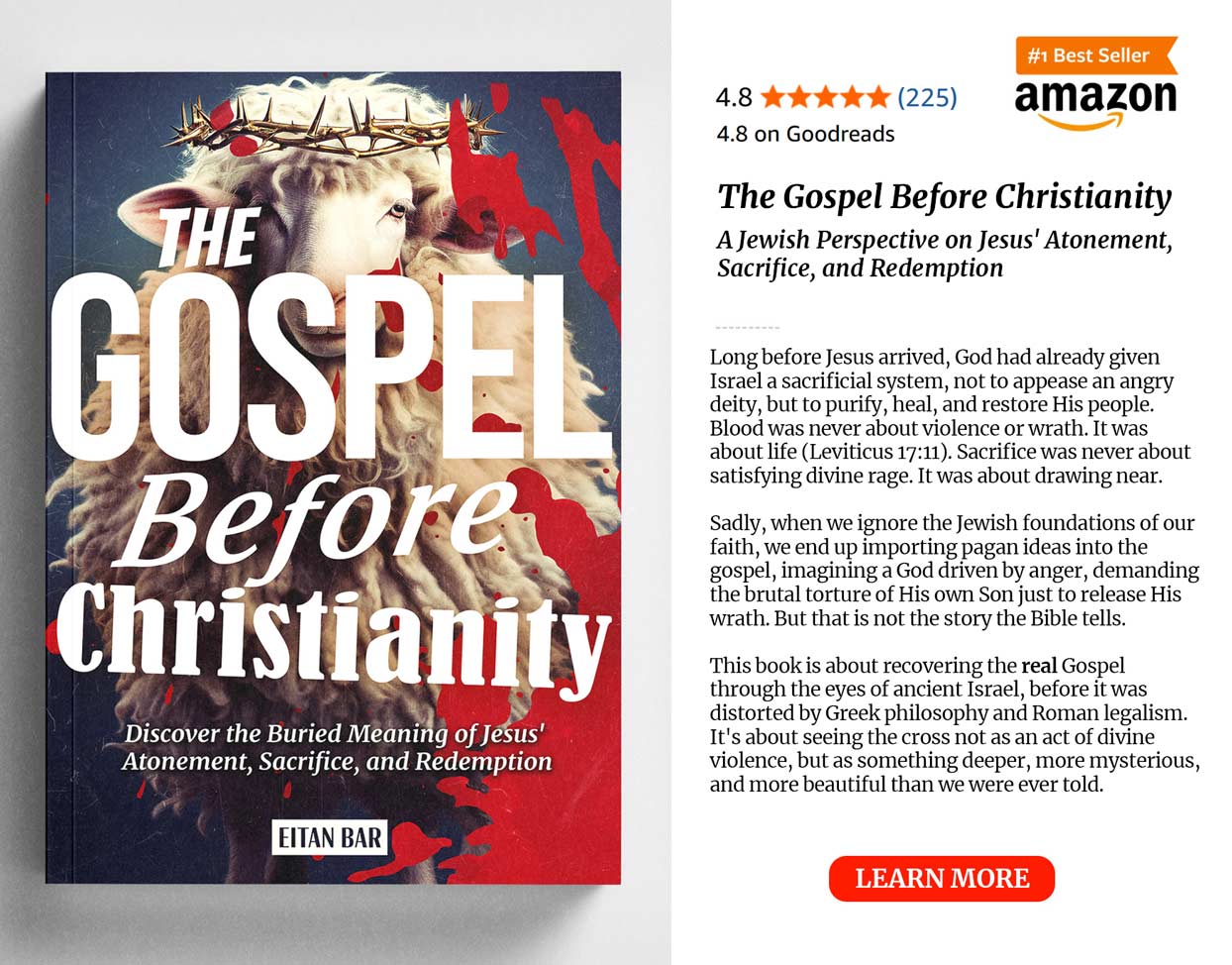
Long before Jesus arrived, God had already given Israel a sacrificial system — not to appease an angry deity — but to teach, heal, and restore His people. Blood was never about violence or wrath — it was about life (Leviticus 17:11). Sacrifice was not about satisfying divine rage — it was about drawing near. Atonement was never about punishment — it was about cleansing, renewal, and return.
Sadly, when we ignore the Jewish foundations of the Christian faith, we end up importing foreign pagan ideas onto the gospel — imagining a God driven by anger, demanding the brutal torture and death of His Son, just to release His wrath and forgive. But that is not the story the Bible tells.
I want to invite you to read my upcoming book, which recovers the real Gospel — through the eyes of ancient Israel — before it was distorted by Greek philosophy and Roman legalism. It’s about seeing the cross not as an act of divine violence, but as something far deeper, more mysterious, and more beautiful than we’ve been told — a truth worth rediscovering.
A story of a God who saves not only souls but also restores what sin broke, heals creation, and overcomes every force that separates us from His love. A story of a God who is truly Mighty to Save.
You can pre-order the book here: