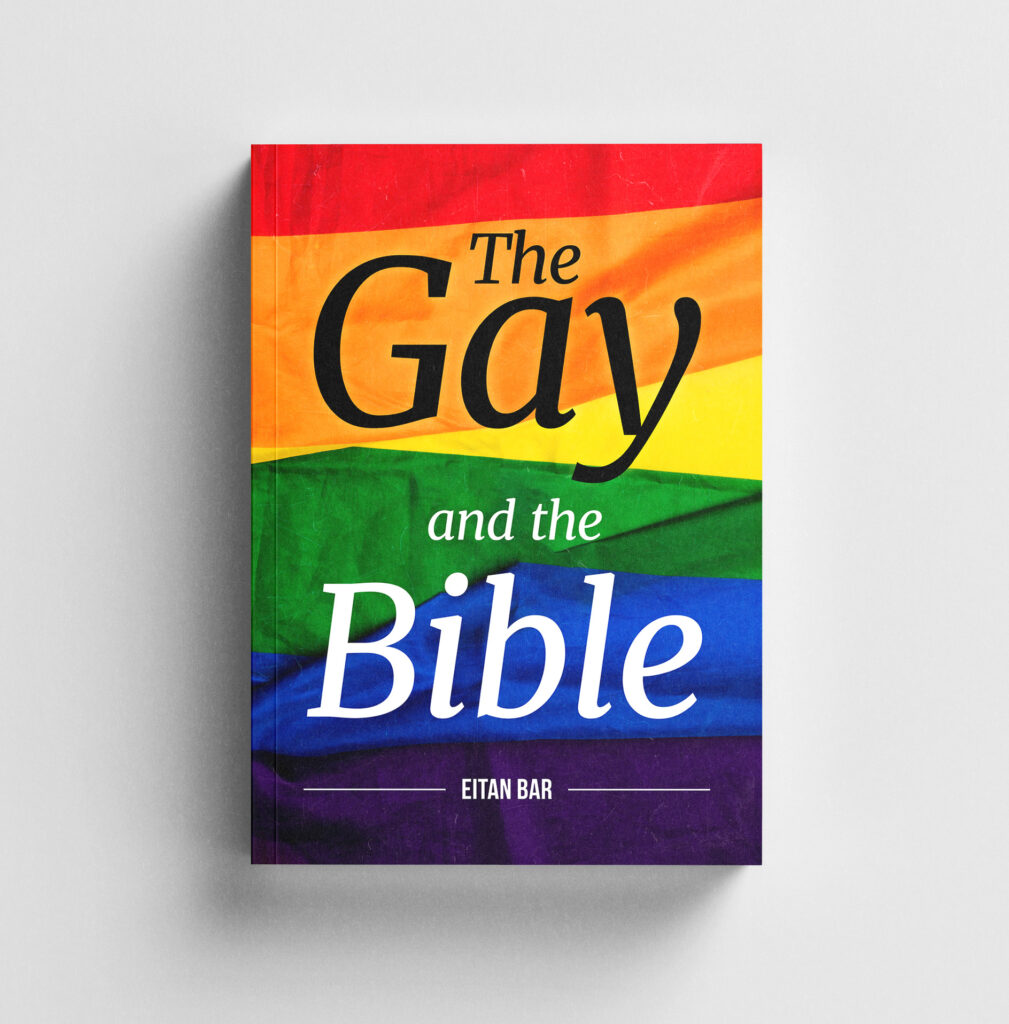
It was five years ago that Dani finally told me what had happened. He had disappeared, and it took him a year to reach out and tell me why he, an Israeli Jew who had accepted Yeshua as his Messiah, had walked away from the messianic faith.
Some context before you read his message. Dani, which is not exactly his real name, was a teenager and a new Jewish believer at the time. When he felt he could finally trust the Messianic church I had connected him to, a decision I now deeply regret, he told them that he had been attracted to men for as long as he could remember. Not that he had slept with a man. Only that he was drawn to them.
Now his message, a year later (September 16th, 2021), translated from Hebrew:
“Let me tell you why I walked away from the faith.
The Body of Christ rejected me. It cast me out.
My Messianic friends abandoned me, lied to me, and eventually forgot about me. My church leaders issued a warning against me because of my sexual orientation.
So why would I stay where I am not wanted?
There were other things too, things I would rather not remember.
I am broken.
I no longer want to believe in Jesus. And the worst part is that I know He is the absolute truth. I know exactly who He is. And still I would rather deny Him, because of His followers.
Believers from all over the country mocked me and blocked me. People who had been my closest friends betrayed me, deliberately, behind my back. It reached the point where I thought about ending my life. There were three days I could not get out of bed.
I am almost eighteen years old, and I am giving up just before the finish line.
So congratulations to the Body of Christ on becoming an exclusive members-only club. I do not want to belong to it anymore. I would rather be in hell with my family and with the friends who stood by me and cared for me all this time, than in the Kingdom of Heaven with the Body of Christ.”
We are still in touch. Dani is in a much better place today, and stronger in his faith than he has ever been. But it took time, and it took a great deal of talking.
I tell you about him because he is the reason I finally sat down to study what the Bible actually says about homosexuality, this time in context.
This book is dedicated to every Dani out there. We will come back to him in a later chapter.
***
A word about the title. You may wonder whether “the Gay” reduces people to a category, and it is a fair question, since reducing people to categories is one of the sins this book exists to protest. I kept it because it names, bluntly, what the church has actually done. It has turned human beings into a doctrine, a topic, an issue, a debate. The title is not my ideal. It is a mirror. My hope is that by the last page you will not be able to read it without seeing a face.
I did not begin this study to prove a point. I am attracted only to women, and I have no horse in this race. I began it because I could no longer ignore the distance between what I had been taught the Bible says and the fruit I watched that teaching produce. So I went back to the text, and slowly I began to see what it actually says, once you stop pulling verses out of context and start reading passages whole.
That gives me no special authority, and I hold my conclusions knowing that serious people read the same Bible and reach different ones. But I do have a stake in this. I have watched what this teaching does to people I love, and a theologian who can watch that and stay neutral has already answered the question with his silence.
I write as a Bible scholar and as a seeker of truth, one who holds that all Scripture is God-breathed (2 Timothy 3:16), and that God-breathed words were never meant to be read as dead letters. Scripture must be read by its spirit and not by its letter alone, “for the letter kills, but the Spirit gives life” (2 Corinthians 3:6).
In biblical interpretation, context is king. Scripture was not written in a vacuum. It was written within concrete historical, cultural, linguistic, and literary settings, and no verse stands alone. Every verse belongs to a paragraph, every paragraph to a chapter, every chapter to a book, and each layer gives meaning to the one beneath it. Words take their sense from their surroundings, and the same Hebrew or Greek word can carry very different weight depending on where it sits and who is using it.
Sound interpretation, then, does not ask only what a text says in the original language. It asks what it meant to the people who first heard it, within their genre, their setting, and their world. Strip that away and interpretation becomes projection. We stop drawing meaning out of the text and start pressing our own assumptions into it.
For much of my life as a follower of Jesus, a journey that began inside the Messianic movement, I accepted its teaching on homosexuality without question. It was presented as settled, beyond challenge, and usually framed in much hatred and fear. To raise a question was to be suspected of taking the other side.
In that world, hatred toward homosexuals was often fueled by conspiracy theories and absurd accusations, such as the claim that they only adopt children in order to sexually abuse them. These portrayals were not only false and sweeping generalizations, but deeply dehumanizing.
Homosexuals were not merely condemned. They were often demonized. There was little room for compassion, less for understanding, and none at all for honest reflection. Homosexuals burn in hell forever, and to think otherwise was heresy.
Christians often feel deeply and rightly opposed to evil because evil produces pain, suffering, injustice, and destruction in human lives. As we will come to see later, this was often the case in biblical times. But in my own experience, the homosexuals I have personally known, Jewish, Christian, and secular alike, were loving, kind, generous, self-giving people who genuinely cared for others and sought to live peacefully and compassionately. I watched some of them sacrifice in ways I have seen very few Christians match.
Of course, as in every human group, there are gay people who are selfish, destructive, or cruel. There are also such people in the synagogue, in the church, and in our own families. I would no more explain their failures by their orientation than I would explain a thief’s by his ethnicity or a liar’s by his hometown.
Character is not distributed by category. The moment we begin assigning virtue or vice to entire groups of people, we have already adopted the logic of the antisemite, the same logic that has been used against my own people for two thousand years. And as a Jew, I know exactly where that kind of reasoning leads.
Most homosexuals I encountered were consistently compassionate, thoughtful, and deeply human, nothing like the distorted caricatures often painted during my years within the messianic circles.
Like the rest of the believers, I assumed that the Bible clearly and unequivocally condemned all forms of homosexual relationships, and that to think otherwise was to betray the faith.
But as I studied more deeply, I began to see that the issue was far more nuanced—and far more human—than I had ever been led to believe.
Recovering the Biblical World Behind Our Modern Debates
This book is the result of biblical study, historical research, and reflection. It does not attempt to rewrite Scripture or bend it to the preferences of modern culture. On the contrary, it seeks to recover the meaning that Scripture’s original audiences would have understood, before centuries of translation, tradition, and cultural distance altered our perception.
Many Christians today find themselves torn between compassion and conviction. They long to love their friends, children, or congregants who identify as gay or lesbian, yet they fear either betraying Scripture or being ostracized by their community if they show acceptance. This inner struggle often results in silence, guilt, and division.
***
This book is written for the ordinary Christian reader: thoughtful, sincere, perhaps unsure. You may be conservative, liberal, or somewhere in between. You may be reading to defend what you believe or to test it. Either way my invitation is the same. Read with an open hand.
Some will wonder whether I am a “woke progressive.” In fact, I hold many conservative convictions. I write as someone who honors the authority of Scripture, the lordship of Jesus, and the call to holiness. But I am convinced that holiness is not a cold separation from other people. It is redemptive love in action, a purity that draws near rather than pulls away, that heals rather than harms.
I have no interest in being provocative for its own sake. I do not write as an activist. I write as a theologian who believes that any doctrine, if it truly comes from God, must be grounded in the text itself and nowhere else, and that no doctrine is ever beyond question.
I was recently emailed by a “very concerned” Messianic leader who was deeply worried that I was writing a book on this subject. He had not even read the book. Apparently, the very fact that the topic was being discussed at all, at least within some fundamentalist circles, was enough to cause alarm.
But why should that be?
The inability to discuss doctrine openly and honestly is not a sign of theological strength. It is a mark of insecurity, and frankly, a source of shame for the Church. No doctrine should be so fragile that it cannot survive sincere questions, respectful disagreement, or serious scrutiny.
Everything can and should be discussed with humility and respect. We do not discover truth by silencing questions. We refine our understanding by asking them. If we are truly confident that we possess the truth, then we should have nothing to fear from honest examination.
You cannot discover, test, or refine truth any other way.
So this book is a journey. It begins by examining the passages that speak about homosexuality, carefully and in context, engaging a few scholars who have shaped the debate, and moves from there to the larger questions those passages open.
So I offer it not as a manifesto but as an invitation. To think. To pray. To study. And above all, to better love others.
May the Spirit who inspired Scripture inspire our reading of it as well.
What I Will Argue in This Book
I kept meeting people who loved Jesus and had been shown the door, and I could not square that with anything I knew about him.
Whatever you conclude about the arguments in this book, I am asking one thing of you that does not depend on agreeing with anything I say. Let them belong. Let gay men and women, and any human, for that matter, sit in the pew, be prayed for by name, be known rather than whispered about, and belong on the same terms as everyone else.
If you finish this book still convinced I am wrong about every single verse, and yet you make room at your table for someone you were taught to keep at a distance, then it will have done the work I most wanted it to do!
Now, a word about where I land, since some readers will want to know before they begin. I am not asking you to celebrate what you believe Scripture forbids, nor to pretend the question is simple. My argument is narrower and, I hope, harder to dismiss.
Here is the claim this book will defend: every passage historically used to condemn homosexuality as a single broad category was in fact written about something specific, mainly idolatry, and always related to idolatry in one way or another. Not about love, but about conquest. Not about covenant, but about cult. Not about two equals who choose one another, but about a body being used, bought, humiliated, or offered to a god. The Bible has a great deal to say about all of that, and it says it with fire. What it never says, anywhere, is a single word about the monogamous, committed gay couple sitting in the church’s third row this Sunday.
If I am right, then the question some have been answering with such confidence is not the question the Bible was ever asked. And where Scripture falls silent, the burden of proof shifts. I will argue further that monogamous, committed love, even when it falls short of the first, ultimate picture painted in Eden, may belong to the long list of ways God stoops to meet us in a fallen world east of the garden. The way He met Israel in its divorces, its kings in their many wives, and all of us in the hardness of our hearts.
You may finish this book unconvinced. That is your right, and I will have failed you honestly rather than flattered you. But you will not, I hope, be able to say the case was thin.
The Scope of This Book
The first part of this book is exegetical: six passages, examined one at a time, in their own languages and their own world:
Genesis 19:1–13—the story of Sodom and Gomorrah.
Leviticus 18:22 and 20:13—the laws of the Holiness Code.
1 Samuel 18 and 2 Samuel 1:26—David and Jonathan.
1 Corinthians 6:9–11 and 1 Timothy 1:9–10—Paul’s use of arsenokoitai and malakoi.
Romans 1:18–32—Paul’s argument against idolatry and moral corruption.
Matthew 19:4–5—Jesus’ reflection on Genesis 1:27.
These passages will be read in context, in their ancient setting, and with theological care. The goal is not to erase moral boundaries but to draw them where Scripture itself draws them: around justice, faithfulness, and holiness, rather than around fear or prejudice.
The second part of this book is theological and pastoral, because the verses were never really the whole question. Once we have seen what these texts say, we still have some other questions to ask, like what kind of God stands behind them. So the later chapters turn to what we mean by sin, how God has always dealt with lives that fall short of Eden, why fear so often wears the costume of holiness, how Jesus treated those whose sin no one questioned, and what the gospel actually promises to people who have been told they are outside it. The first part asks what the Bible says. The second asks who God is. I am not sure the first question can be answered honestly without the second, and vice versa.