The link between the city of Sodom and homosexual acts, from which the word “sodomize” comes, is largely a later cultural reading rather than a careful one. In Genesis 19, the sin of Sodom is indeed an attempted act of collective sexual violence, but it was directed at visitors who were not even human. Over time, through commentary and tradition, “Sodom” became shorthand for homosexual lust, and that reading went on to shape Western language, theology, and law.
It is much like the familiar picture of three wise men at the manger. The text never gives us a number. Three gifts are mentioned, and somewhere along the way the gifts became men. In the same way, the link between Sodom and homosexuality tells us more about the Western imagination than about the biblical text. Even Ezekiel 16:49, which states Sodom’s sin outright, says nothing about homosexuality.
In this chapter, we will set aside the layers of tradition that have accumulated over the centuries and go back to the text itself, to see what it actually says.
Now let us read the passage itself, Genesis 19:1-13. Before you do, one thing you need to know. In the ancient Near East, hospitality to strangers was a sacred obligation, not a nicety, and the threat of gang rape was a known instrument of humiliating outsiders and conquered men.
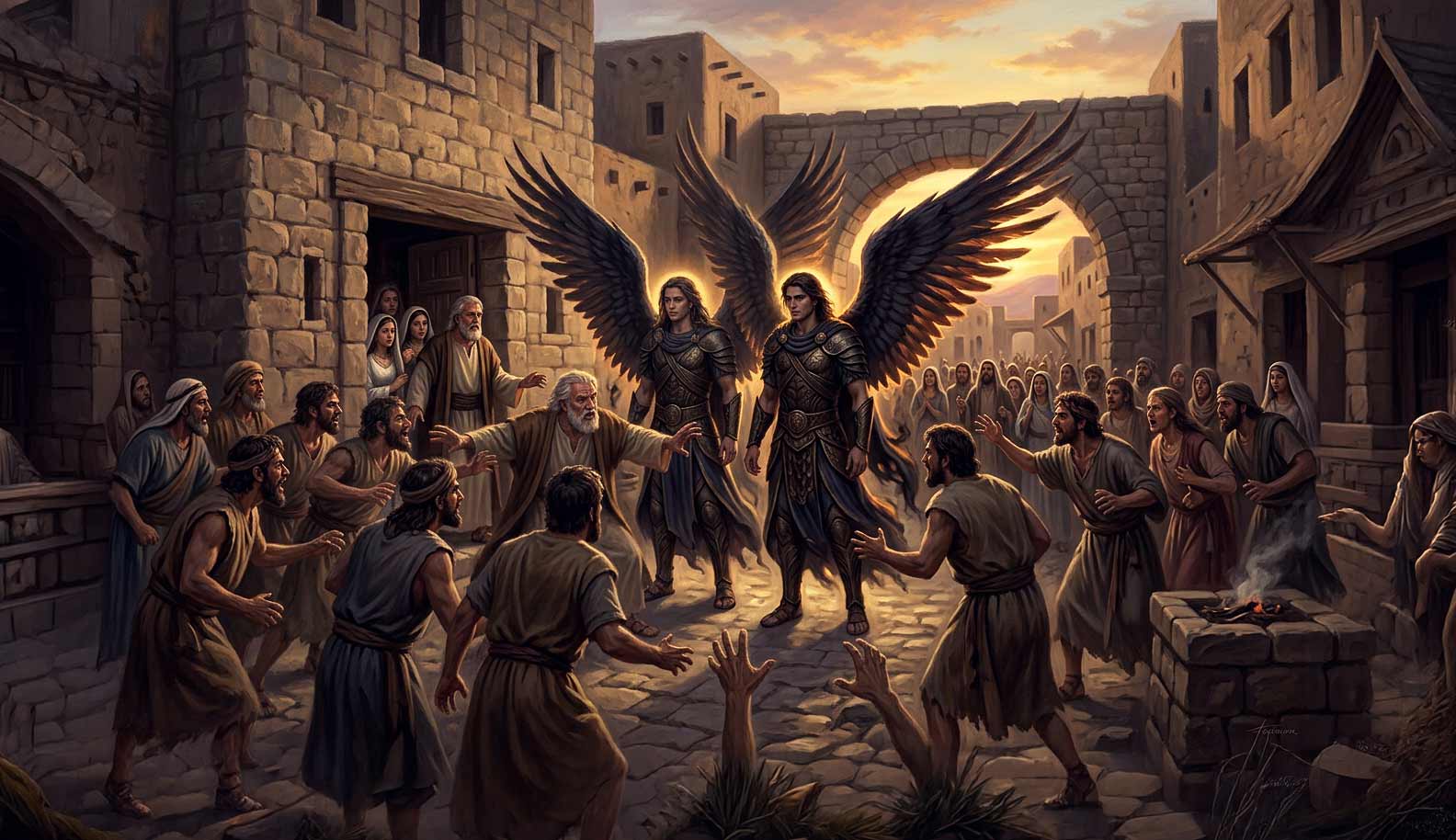
1 Now the two angels came to Sodom in the evening as Lot was sitting at the gate of Sodom. When Lot saw them, he stood up to meet them and bowed down with his face to the ground. 2 And he said, “Now behold, my lords, please turn aside into your servant’s house, and spend the night, and wash your feet; then you may rise early and go on your way.” They said, “No, but we shall spend the night in the public square.” 3 Yet he strongly urged them, so they turned aside to him and entered his house; and he prepared a feast for them and baked unleavened bread, and they ate. 4 Before they lay down, the men [Hebrew: people] of the city—the men [people] of Sodom—surrounded the house, both young and old, all the people from every quarter; 5 and they called to Lot and said to him, “Where are the men [people] who came to you tonight? Bring them out to us that we may have relations with [Hebrew: know] them.” 6 But Lot went out to them at the doorway, and shut the door behind him, 7 and said, “Please, my brothers, do not act wickedly. 8 Now look, I have two daughters who have not had relations with any man; please let me bring them out to you, and do to them whatever you like; only do not do anything to these men [people], because they have come under the shelter of my roof.” 9 But they said, “Get out of the way!” They also said, “This one came in as a foreigner, and already he is acting like a judge; now we will treat you worse than them!” So they pressed hard against Lot and moved forward to break the door. 10 But the men [people] reached out their hands and brought Lot into the house with them, and shut the door. 11 Then they struck the men [people] who were at the doorway of the house with blindness, from the small to the great, so that they became weary of trying to find the doorway. 12 Then the two men said to Lot, “Whom else do you have here? A son-in-law and your sons and daughters, and whomever you have in the city, bring them out of the place; 13 for we are about to destroy this place, because their outcry has become so great before the Lord that the Lord has sent us to destroy it.”
(Genesis 19:1-13)
Seen from above, the story of Sodom draws a sharp contrast, and it is not between the straight and the gay. It is between the righteous man who takes complete strangers—two angelic beings—into his home, gives them a bed and sets a feast before them, and a city that wants to seize those same strangers and use them in the most degrading way it can imagine. That is the point of the story.
Opening the Text: A Boundary Crossed at Twilight
The story opens at the edge of night, as two celestial visitors—neither human male nor human female—arrive in Sodom. Lot rises to meet them, bows, and insists on sheltering them within his house (Genesis 19:1–3). Before they can lie down, “the men of Sodom, both young and old, all the people to the last man, surrounded the house” and demanded: “Bring them out to us, so that we may know them” (Genesis 19:4–5). Unlike some English translations, the original Hebrew text doesn’t say “men of Sodom” but simply states “Anshei Hair,” “people of the city.”
Then Lot steps outside, closes the door behind him, and pleads, “Do not act so wickedly,” shockingly offering his own human daughters—not his sons—instead (Genesis 19:6–8), a perplexing gesture if all those present were truly homosexual men.
The crowd presses in; the angelic visitors strike them with blindness and announce the city’s doom (Genesis 19:9–13).
The Common Interpretations
I respectfully disagree with the fundamentalist interpretation suggesting that the people of Sodom were entirely homosexuals, as in John MacArthur’s claim, “Sodom was a whole civilization of homosexuals”. I also disagree with the progressive interpretation that claims the people of Sodom were destroyed merely because they failed to show hospitality, as though the moral of the story were about bad manners. This effort to depict God as “not cruel to homosexuals” ultimately portrays Him as equally harsh to those who lack social grace. In trying to solve one problem, the progressive view creates another, and in the process, strays far from the meaning of the text itself. Instead, I believe the story reveals something entirely different; something most readers overlook, something far deeper, darker, and more profound. But we’ll get to that later in the chapter.
Before the deeper reading, I would like to make two points.
First: This Is a Crime Scene, Not a Love Story
Before we descend into the deeper layers of this text, let us establish something on its plain surface, something that requires no Hebrew, no theory, and no special interpretation of the visitors’ identity. Whatever else Genesis 19 is, it is the story of an attempted gang rape of two angels. An entire city surrounds a house at night and demands that the divine guests be handed over for violation. Lot begs them not to act wickedly. They threaten him. They surge toward the door. Only a miracle of blindness stops them.
Now ask the obvious question: what does any of this have to do with two people who love each other?
Nothing in this scene is freely chosen. Nothing is mutual. Nothing is tender, covenantal, or faithful. There is no relationship here at all, only a mob and its prey. To reach for this text in a conversation about a lesbian couple who have shared a home, a table, and a life for thirty years is not exegesis; it is a category mistake of the most basic kind.
We would never dream of using the gang rape of the Levite’s concubine in Judges 19, a story deliberately told in Sodom’s shadow, with the same nighttime mob, the same pounding on the door, the same horrific offer, as evidence about the morality of marriage between a man and a woman. Yet that is exactly the logic applied to Genesis 19 whenever it is quoted against homosexuals: a story of sexual violence pressed into service against sexual love.
So let this stand as the first and firmest conclusion of this chapter, one that does not depend on anything I will argue afterward: Genesis 19 depicts attempted rape, and rape can teach us nothing about love. On that ground alone, the text cannot carry the weight that the fundamentalist tradition has placed on it. Everything that follows is a second layer, not the foundation.
Second: “All the People”: Crowd Language, Not Just the Men
The Hebrew of Genesis 19:4 makes it clear that “all the people” surrounded the house, not just the males, as implied in some English translations. Even the phrase “all the men,” used throughout the Bible in many English translations, serves as an idiomatic expression meaning “everyone,” rather than a literal claim that only male citizens were present.
So even when the terms “all men,” “every man,” or “men of the city” appear in English Bibles, they do not exclusively mean “only males.” “All men” is generally understood as “everyone.” For example, Psalms 116:11 states, “All men are liars.” This does not imply that men, but not women, are liars. In its biblical context, “men” refers to humanity in general. The point is that all people, regardless of gender, are unreliable. Similarly, in John 13:35, when Jesus tells his disciples, “By this shall all men know that ye are my disciples, if ye have love one to another,“ Jesus clearly refers to all humankind, not just men. Likewise, 1 Timothy 2:3-4 says, “God our Saviour; Who will have all men to be saved, and to come unto the knowledge of the truth.” Here again, “all men” means everyone, not exclusively males. This interpretation is consistent with 1 Corinthians 9:22, where Paul states, “To the weak, I became as weak, that I might win the weak. I have become all things to all men, that I might by all means save some.” Paul is talking about reaching out to everyone, not just men but women as well (Acts 16:13).
This clearly contradicts MacArthur’s interpretation. The Genesis 19 account implies that the entire population of Sodom—men and women, young and old—gathered and participated in the event, which helps explain the city’s collective judgment.
The narrative portrays moral saturation: the will of the entire community uniting in a single act of desecration. This total collapse of righteousness sets the stage for the scope of divine judgment that follows. In such a boundary crisis, the entire social order becomes complicit (Genesis 19:24–25).
That alone would be enough to retire Genesis 19 from this debate. But the text itself invites us further in. Scripture does not merely record Sodom’s violence; it interprets it, and the often overlooked interpretation it offers through Jude and Peter is stranger and more profound than either the fundamentalist or the progressive reading has noticed.
Reading Sodom through the Lens of Genesis 6
Genesis 6:1–4 stands as a gate between worlds. There, “the sons of God saw that the daughters of humans were beautiful, and they married any of them they chose.” (Genesis 6:2). The offspring, the Nephilim, become “mighty men of old,” and violence fills the earth, precipitating the flood (Genesis 6:4–5).
Early Jewish and Christian readers did not domesticate this as human clan intermarriage; they understood “sons of God” (Hebrew: bene ha’elohim) as divine beings who abandoned their domain to seize human flesh—”strange flesh”—a view reflected in Job 1:6; 2:1; 38:7 and in the Dead Sea Scrolls reading of Deuteronomy 32:8 (“sons of God”), as well as reinforced by both ancient and modern scholars.
Second Temple literature (e.g., 1 Enoch 6–11) calls these beings “Watchers” who taught forbidden knowledge and sired destructive giants. The New Testament presumes this backdrop when Peter and Jude refer to angels who “did not keep their own position, but left their proper dwelling” (2 Peter 2:4; Jude 1:6).
And here we are again in Genesis 19, only this time the boundary is being crossed in the opposite direction. It is no longer fallen angelic beings taking human women. Now we have humans attempting to take angelic beings, and the fact that Lot offers his own daughters to stop them tells us just how seriously the ancient world viewed this kind of divine boundary violation.
Lot’s Offer: A Window into Ancient Ethics and the Text’s Real Emphasis
Lot’s appalling proposal—offering his human daughters—must be read descriptively, not prescriptively. The narrator neither commends nor excuses it; it exposes a cultural fallen-ness where the violation of heavenly visitors is seen as an even greater sacrilege than a grievous sin against one’s own family (Genesis 19:8). That moral hierarchy, however grotesque to us, reveals what the crowd sought: not ordinary rape of humans (already evil) but the desecration of the divine council’s messengers. The scene’s logic pivots on the visitors’ identity; not humans but celestial beings. The passage clearly begins by referring to them as “two angels” (Genesis 19:1). This is the prologue and the theological center from which the story takes its force.
This point cannot be overstated: to interpret Genesis 19 as a condemnation of homosexuality, the text would first have to present Lot’s visitors as ordinary human males. But the narrative explicitly identifies them as angelic beings, making the nature of the episode and the violation being portrayed far more complex than a simple account of consensual or even non-consensual same-sex relationships.
As mentioned, the very first verse already explicitly identifies them as “two angels.” This identification raises a critical question: If, as John MacArthur claims, “Sodom was a whole civilization of homosexuals,” then why would Lot offer his female daughters rather than his male “sons‑in‑law” (Genesis 19:14)? Lot’s willingness to offer his daughters cuts against the assumption that the men of Sodom were driven by exclusive homosexual desire. He had lived among these men for years; a desperate man offers what he thinks might satisfy the mob, not what he knows is useless to them.
“Do Not Act Wickedly”
Lot says to the men, “Do not act wickedly. Now look, I have two daughters who have not had relations with any man; please let me bring them out to you, and do to them whatever you like.” (Genesis 19:8).
Think about it: instead of being seen as “acting wickedly,” Lot suggests that the people of Sodom rape his daughters. Somehow, permitting such an act wasn’t considered as wicked.
Rape is a topic that is not unfamiliar in the biblical narrative, as evidenced in instances such as Genesis 34, Deuteronomy 22, and Judges 19–21. Here, Lot offers his daughters to a mob to be raped to make sure they “do not act wickedly.” Rape to avoid wickedness? This suggests that Lot perceived the act of having sexual relations with angelic beings as far greater evil than his human daughters getting raped.
This distinction in the narrative highlights a disturbing but important aspect of the ancient moral world: sexual violation of the boundary between humans and heavenly beings was apparently regarded as an especially grievous offense. Lot seems to have understood that there was something uniquely “wicked” about the men of Sodom attempting to have sexual relations with angels. The fact that he was willing to offer his own daughters instead reveals just how radically different the moral and social assumptions of that world were from our own.
So the critical factor in this scenario is the true nature of the visitors. Engaging in sexual relations with foreign flesh is an entirely different matter from homosexuality. In Lot’s perception, the intent of the people of Sodom to engage sexually with these celestial entities was particularly reprehensible.
Furthermore, reading about the great wickedness brings to mind the use of that same term just a few chapters earlier, also in relation to angels:
The Nephilim were on the earth in those days, and also afterward, when the sons of God came in to the daughters of mankind, and they bore children to them…The LORD saw how great the wickedness of the human race had become on the earth…
(Genesis 6:4-5)
In this context as well, wickedness is associated with humans having sexual relations with angelic beings, not homosexuality. This was Sodom’s wickedness as well.
Ezekiel, Jude, and Peter: Three Witnesses Clarify Sodom’s Sin
Ezekiel 16:49-50
Behold, this was the guilt of your sister Sodom: she and her daughters had arrogance, plenty of food, and carefree ease, but she did not help the poor and needy. So they were haughty and committed abominations before Me. Therefore I removed them when I saw it.
Ezekiel 16 first indicts Sodom for arrogance and neglect of the poor, then for “abominations.” These abominations are not exhaustively defined. Only later, Jude supplies the missing link by comparing Sodom’s pursuit of “strange flesh” with the angels’ own boundary violation (Jude 6–7). Peter confirms the triad of events—angels sinning, the flood, Sodom’s destruction—in a single chain of exempla (2 Peter 2:4–6). Read together, the prophets and apostles present Sodom not merely as a case of inhospitality, nor do they address homosexuality, but rather depict it as a mirrored reenactment of Genesis 6’s transgression at the level of created orders.
2 Peter 2:4-6
For if God did not spare the angels when they sinned…and if he did not spare the ancient world, even though he saved Noah…when he brought a flood on the world of the ungodly; and if by turning the cities of Sodom and Gomorrah to ashes…
(2 Peter 2:4-6)
It doesn’t get any clearer than that. Draw the threads of Ezekiel, Jude, and Peter together, and the same picture emerges: the grave sin bound up with Sodom had to do with sexual relations that crossed the boundary between humans and angelic beings. And notice what is missing. Not one of them, not Ezekiel, not Jude, not Peter, ever names homosexuality. These passages echo one another in language and story, and what they describe is angels abandoning their appointed realm to pursue union with “strange” flesh that was never theirs to touch. That transgression, not homosexuality, is what brought down the judgment.
Consider, too, how Peter frames the story. In 2 Peter 2, the sin of the angels and the judgment of the flood in Noah’s day are placed side by side, and that proximity is unlikely to be accidental. The passage creates a clear narrative connection between the angels’ transgression and the corruption that followed.
Read alongside Genesis 6, the implication becomes striking: the angels’ unnatural union with human beings was not merely an isolated act of rebellion. It contributed to a broader corruption that spread through humanity and helped bring the earth to the moral brink. The result was a world filled with violence and wickedness, until the flood became the divine response to a creation that had been thoroughly corrupted.
Likewise, Sodom’s central sin was the desire to engage with the angels who came to the city. If, in Genesis 6, the angels were the ones who initiated the forbidden sexual contact and yearned for human flesh, then here the roles are reversed, and it is the human who wickedly longs for the strange flesh, the flesh of the angel.
When the New Testament reaches for Sodom, it does so in several places, and never points to homosexuality (Matthew 10:15; 11:23–24; Luke 10:12; 17:29; Romans 9:29; Revelation 11:8). Only two of these texts pause to name the nature of Sodom’s sin, and when they do, both reach for the same startling comparison: the boundary-crossing of angels (2 Peter 2:4–6; Jude 6–7). That pattern is crucial.
“Strange Flesh”? What Jude Actually Says
The phrase “strange flesh,” “other flesh,” or “foreign flesh” (depending on the Bible translation) signifies an angelic desire for human flesh rather than a homosexual desire between two male humans.
Logically, too, two males are not strange flesh at all; they are, in fact, the same kind of male human flesh. The act of homosexuality occurs within the boundaries of the same gender, race, and species, meaning the very same flesh. ‘Strange’ means something foreign or opposed to the flesh to which it is foreign. Jude’s phrase in verse 7 is precise: Sodom “went after strange[/foreign/other] flesh” (Greek: sarkos heteras). This alone is enough to seriously undermine the interpretation of Genesis 19 as a reference to homosexuality.
The men of Sodom attempted to violate angels, just as the angels of Genesis 6 violated human women. This is not an attempt to sanitize the ugliness of Sodom’s lust; it is to identify its unique blasphemy.
Why the Judgment Was So Severe
Same-sex relationships were present in several ancient civilizations during the time of Genesis, including Mesopotamia, Egypt, and Canaan. In Mesopotamian literature, such as the Epic of Gilgamesh, intimate male bonds are portrayed with emotional depth, and temple rituals sometimes included sacred prostitution involving both genders. The Egyptian tomb of Niankhkhnum and Khnumhotep depicts two men in an intimacy usually reserved for husband and wife, and some have read it as evidence of a romantic partnership (though it is also possible the depiction is of two brothers). The tomb is suggestive, not decisive, and I mention it only to show that the ancient world was not naïve about romantic or sexual affection between men. Canaanite and other Semitic cultures practiced same-sex acts as part of pagan fertility rites and religious ceremonies, which later biblical texts reacted against.
Thus, homosexuality was present in many ancient societies. So Sodom was not unique in this regard, and its destruction cannot be explained solely on the basis of homosexual behavior. Sodom’s destruction may, however, be understood as judgment against a forbidden union between what is human and what is not: an attempted violation of the boundary God set between created orders. Scripture records only two occasions where the boundary between human and angelic flesh is crossed or attempted, and both belong to a world gone rotten. In Genesis 6 it comes just before the flood. In Genesis 19 it comes just before the fire. As the late biblical scholar Michael S. Heiser demonstrated at length, this is precisely how Second Temple Judaism and the New Testament writers understood the sin of the Watchers in Genesis 6, and Jude reads Sodom as its mirror image.
Throughout Scripture, the scale of judgment matches the kind of sin. The flood answers a cosmic violation of angels crossing into human flesh (Genesis 6:1–5). Fire from heaven answers the inverse attempt of humans grasping at angelic flesh (Genesis 19:24–25). Both judgments protect the created boundary that secures the world’s order.
As in Eden—“the woman saw… she took” (Genesis 3:6)—the verbs of trespass echo in Genesis 6—“the sons of God saw… they took” (Genesis 6:2). Then, in Sodom, the same pattern appears in reverse: they see the visitors and seek to take them. The narrative of seeing and taking reinforces the theme of boundary violation running through these narratives and best explains the catastrophic events leading to Sodom’s destruction.
Answering Common Objections
Objection 1: “The mob did not know the visitors were angels, so their intent was simply to rape men. Doesn’t that make the sin homosexual after all?”
This is the strongest form of the objection, and it deserves a straight answer.
First, it is true that the men of the city did not call out, “Bring out the angels.” But notice what this concedes and what it does not. It concedes that the scene is about rape, domination, and the brutal humiliation of strangers, which is exactly my point: it is not about love, covenant, consensual, or anything we would recognize as orientation. A mob assembling to violate guests by force tells us nothing about whether two people of the same sex may love each other faithfully, any more than the gang rape of the Levite’s concubine in Judges 19, a story deliberately written to mirror this one, tells us anything about the goodness of marriage between a man and a woman. Whether or not you accept the deeper reading of “strange flesh,” the surface of the text already refuses to be a weapon against the gay couple living across the street. The sin of Sodom was cruelty wearing the mask of sex. That alone settles the matter for our purposes.
Second, Genesis 19 is written for the reader, and it tells us from the opening line exactly what these visitors are: two angels arriving at Sodom in the evening. That framing is deliberate. Whatever the crowd outside believed they were dealing with, the narrator has already told us, and our reading is shaped by it from the start. So the question of what the men of Sodom perceived is not where the weight of the story lies. What the text puts in front of us is a mob demanding to gang-rape guests who had come under a host’s protection, guests the reader knows in advance are angelic messengers of heaven. That is the outrage the narrator wants us to feel, and he has arranged the scene so we cannot miss it.
It’s clear that Ezekiel, the New Testament writers, and the author of Genesis all saw the narrative as being about the crossing of boundaries between two species. They never mentioned homosexuality. Not even once.
Objection 2: “Sodom’s sin was only inhospitality.”
Hospitality in the ancient Near East was sacred, and Sodom is indeed guilty of violence and cruelty. Ezekiel names arrogance and neglect of the poor. But Genesis 19’s narrative climax is not refusal of bread; it is the attempted sexual violation of angels. The men’s demand to “know” the visitors, Lot’s horror, his dreadful alternative, and the angels’ direct intervention all focus the issue on a profanation aimed at heavenly messengers (Genesis 19:5–11). Jude’s “strange/other flesh” confirms a transgression beyond inhospitality (Jude 7).
Objection 3: “Jesus said angels cannot marry, so Genesis 6’s premise (and thus your mirror) is impossible.”
Wrong. Jesus says that “in the resurrection they neither marry nor are given in marriage, but are like angels in heaven” (Matthew 22:30). He describes order in the age to come and the nature of angels “in heaven,” not the capacities of rebellious fallen angels on earth who abandoned their estate (Jude 6). Jesus does not contradict the Old Testament, which shows angels taking embodied form, eating, walking, wrestling, and having sexual relations with humans (Genesis 6:1–2; 18:1–8; 19:1–3; 32:24–30). The Watchers’ sin is precisely that they crossed a divinely drawn line; the men of Sodom sought to cross it back.
Objection 4: “Ezekiel never mentions angels; therefore this reading is imported.”
Ezekiel indicts the city’s pride, neglect, and “abominations” (Ezekiel 16:49–50). Jude supplies the interpretive key by explicitly pairing Sodom’s sexual pursuit with angelic transgression (Jude 1:6–7). Scripture interprets Scripture. Ezekiel writes “abominations”; the New Testament clarifies the boundary-specific abomination. Both are true, together explaining why the judgment was total.
Conclusion: Coercion and Strange Flesh
This chapter has offered two readings that arrive at the same conclusion.
On the surface, Genesis 19 is a story of attempted mob rape. And rape, by its very nature, can tell us nothing about the morality of loving, consensual same-sex relationships.
Beneath the surface, however, Scripture’s own interpreters point to something even stranger: Genesis 19 fits into a larger biblical pattern of boundary violation between the human and heavenly realms:
In Genesis 6, celestial beings cross the boundary into human flesh, and the flood answers this transgression (Genesis 6:1–5).
In Genesis 19, the pattern is mirrored in reverse: humans attempt to violate angelic beings, and fire answers the attempted profanation (Genesis 19:1–11, 24–25).
Jude and 2 Peter then connect these episodes explicitly, placing the sin of the angels, the days of Noah, and Sodom within the same chain of divine warning (Jude 6–7; 2 Peter 2:4–6). Jude’s reference to “strange flesh” further reinforces the idea that the issue involves a transgression of an unusual boundary, not a simple condemnation of consensual same-sex relationships.
The moment God promised in Genesis 3:15 that the woman’s seed would crush the serpent’s head, Satan had his target: the human DNA. If he could corrupt that line, he could stop the Deliverer before He was ever born.
So the point is not an abstract curiosity but a theological axis: God guards creation’s borders and human DNA to preserve life and redemption; when heaven or earth grasps beyond those borders, judgment protects the world God loves.
Thus, in this reading, the “sons of God” who take human wives and father the Nephilim are fallen angels (or their demonic offspring), and their aim is to pollute humanity’s DNA with a corrupted, non-human element. Poison the well, and the promised Seed can never come through it.
This is why, defenders of the view argue, the flood had to be so total: Noah is described as “perfect in his generations,” which is read not as morally blameless but as genetically uncorrupted, one clean bloodline preserved so the promise could still be kept.
On this reading, the war over “seed” runs straight through Scripture. Satan keeps trying to break the line, and God keeps preserving it.
Sodom, then, is not a blunt instrument against our neighbors. It is a mirror held up to a cosmos prone to trespass and a mercy fierce enough to stop it.
This reading does not minimize Sodom’s evil; it intensifies it. Nor does it weaponize the passage against those who experience same-sex attraction. The narrative does not portray consensual, covenantal human relationships; it portrays an attempted angelic desecration by a violent mob. Conflating these is a category mistake with devastating pastoral consequences. Homosexuals are not fallen angels or giants; they are sons and daughters and God’s image, seeking grace, love, and belonging.
If our interpretation of Genesis 19 produces contempt rather than compassion, despair rather than discipleship, we have misread the heartbeat of Scripture. The church must read Genesis 19 with gravity and with the gospel in view. Gravity, because creation’s boundaries are not negotiable; gospel, because the One who set them has come near to heal every wound we have made.
In conclusion, when read in its proper context, Genesis 19 alone does not provide sufficient grounds for a sweeping condemnation of all forms of same-sex relationships.
This was a free chapter from my book on homosexuality in the Bible.
Order the book here