Where does the Bible say that the moment of death closes the door?
Everyone knows the doctrine. The line is drawn at your last breath, and after it nothing can be changed, ever. In the Western church, it is so universally assumed that most believers have never once wondered where it came from.
Almost always, the verse offered is Hebrews 9:27: “people are destined to die once, and after that to face judgment.”
Read it carefully, because it is doing less work than you have been told. It says two things happen in sequence. You die, then you are judged. That is all. It says nothing about the purpose or the duration of the verdict, nothing about whether repentance remains possible afterward, and nothing whatsoever about a door. It establishes that there is a reckoning. Everything else has been poured into it.
And it is only half a sentence. The writer goes on: “so Christ was sacrificed once to take away the sins of many” (Hebrews 9:28). His point is the word “once.” Human beings die once; Christ was sacrificed once, and that one sacrifice does not need repeating. He is talking about the cross, not drawing a map of the afterlife.
The Deadline Peter Never Heard Of
Peter writes that Christ, after His death, “went and made proclamation to the imprisoned spirits, to those who were disobedient long ago when God waited patiently in the days of Noah” (1 Peter 3:19-20).
Sit with who that is. Not the borderline cases. Not the almost-righteous. The generation of the flood, the most thoroughly condemned people in the Hebrew Bible, the ones God wiped off the face of the earth. They had been dead for millennia. Their deadline had passed longer ago than anyone else’s in Scripture. And one of the first things we are told Christ did on the far side of death was go to them.
“Imprisoned spirits” could refer to the fallen angels of Genesis 6, read through 1 Enoch, which Peter’s readers knew well. On that reading, Christ is not offering anything to anyone. He is announcing His victory to the powers that held creation hostage.
But then comes the next chapter, and the next chapter is unmistakably about people.
“For this is why the gospel was preached even to those who are dead, that though judged in the flesh the way people are, they might live in the spirit the way God does.”
(1 Peter 4:6, ESV)
If you read the NIV, which I quote throughout this book, you will find a different wording: “the gospel was preached even to those who are now dead.” The word “now” is not in Peter’s Greek. It’s a Protestant addition. He wrote nekrois euēngelisthē, literally “the gospel was preached to dead people.” Add “now,” and the preaching quietly slides back into their lifetimes: they heard it while alive and have since died. Without it, Peter is saying what the King James said four centuries ago: the gospel was “preached also to them that are dead.”
A translation added a word, and with it the deadline stays in place.
The gospel was preached. Not a verdict. Not a notice of defeat. Not an offer. The good news that says they will be resurrected is the gospel they heard.
Angels are not evangelized. Angels are not “judged in the flesh the way people are.” These are human beings. People who had already died, who were preached to anyway, and whose outcome Peter describes not as sentencing but as life.
None of this would have sounded strange to Peter. He was a Jew, and in the Hebrew Bible the realm of the dead is not beyond God’s reach. “If I make my bed in the depths, you are there,” says the psalmist (Psalm 139:8), and the word he uses is Sheol. Hannah sang that the LORD “brings down to the grave and raises up” (1 Samuel 2:6), and the word again is Sheol.
Two centuries before Jesus, Judas Maccabeus sent an offering to Jerusalem and prayed for his fallen soldiers, “so that they might be delivered from their sin” (2 Maccabees 12:43-45, NRSV). Here in Israel, as everywhere Jews live, mourners still say Kaddish for a parent every day for eleven months, and the standard code of Jewish law, citing a medieval Jewish work, says that when a son does this in public, “he redeems his father and mother from Gehinnom.” Jews have never stopped praying for their dead, because Jews have never believed the dead are out of God’s hands.
So where exactly is the deadline? Peter did not seem to know about it. If it existed, he missed it by several thousand years, because the people he describes were already long past it when Christ came for them.
They Put It in the Creed
The early church did not find any of this embarrassing. They confessed it.
Around AD 165, Melito of Sardis preached an Easter sermon in which Christ says: “I am the one who destroyed death, and triumphed over the enemy, and trampled Hades under foot, and bound the strong one, and carried off man to the heights of heaven.” Around 180, Irenaeus wrote that “the Lord descended into the regions beneath the earth, preaching His advent there also,” and declaring “the remission of sins received by those who believe in Him.”
Around 200, Clement of Alexandria stated it flatly, “the Lord preached the Gospel to those in Hades,” and then asked the question this whole chapter is asking:
If, then, He preached the Gospel to those in the flesh that they might not be condemned unjustly, how is it conceivable that He did not for the same cause preach the Gospel to those who had departed this life before His advent?
That is a Christian teacher, eighteen centuries ago, looking for the deadline and not finding it either.
In time, the church wrote it into its confession. Say the Apostles’ Creed out loud. After “was crucified, died, and was buried,” it continues: “He descended to the dead” (older English versions say “into hell”). That line was actually a latecomer. Around AD 404, Rufinus of Aquileia noted that his own church’s creed had it, but that it “is not added in the Creed of the Roman Church, neither is it in that of the Oriental Churches.” He thought it was already implied in the words “He was buried.”
When the sentence was finally written in, there is no record that anyone objected. It was not news. Christians had been preaching it since Peter. Nobody thought to add a clause explaining that He went down only to look around.
The Eastern church built an entire visual tradition on it. Walk into any Orthodox church at Pascha and look at the icon of the Resurrection. It does not show an empty tomb. It shows Christ standing on the shattered gates of Hades, reaching down and hauling Adam and Eve out of their graves by the wrists.
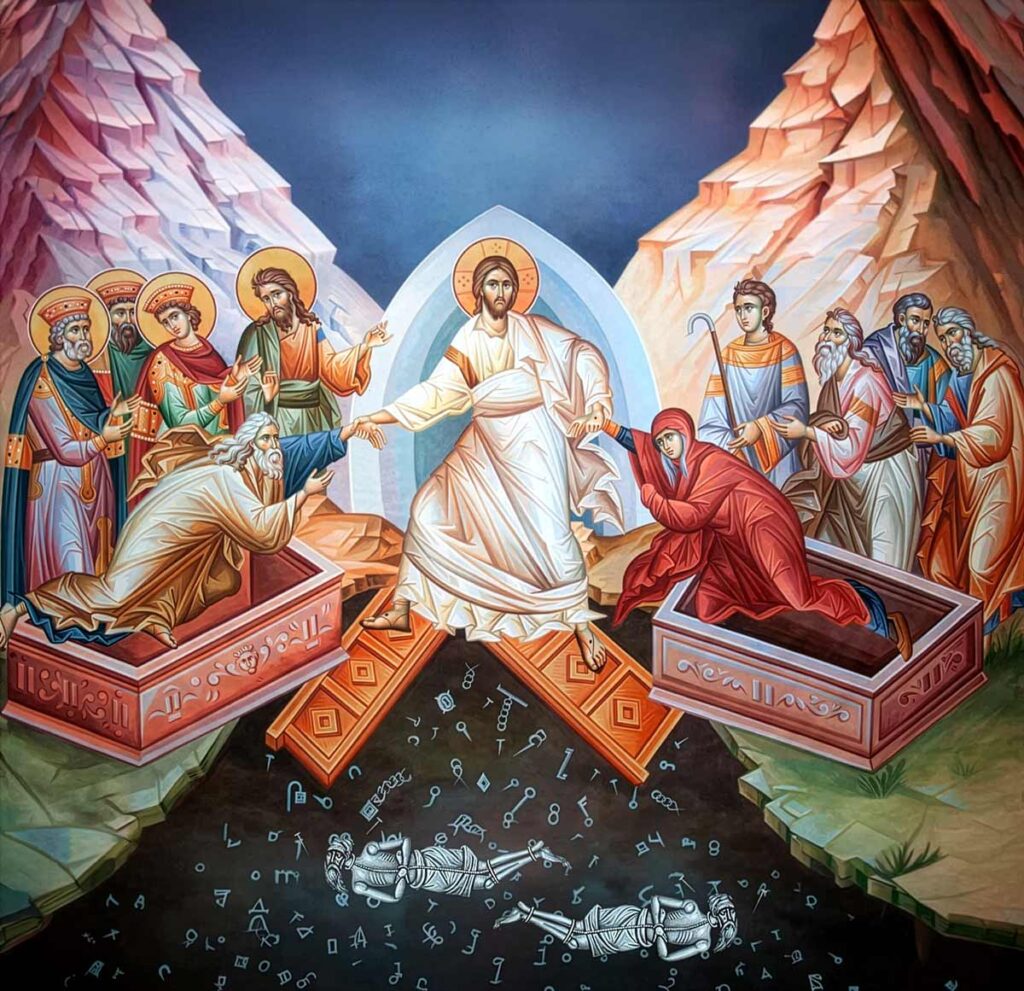
Look closely at what that icon is saying. The gates are not opened. They are broken off their hinges, lying in pieces under His feet. Whatever door the later theologians found, the painters of the ancient church had already seen it smashed.
That is the image the Eastern church has painted for more than a thousand years. Not a vacated grave but a raided one. And every Easter night, Orthodox churches read aloud an old homily that puts the same picture into words: “[Hell] took a body, and met God face to face… Christ is risen, and not one dead remains in the grave.” And that is the gospel: salvation from death itself.
Even Augustine Could Not Close It
Jesus warned that whoever speaks against the Holy Spirit “will not be forgiven, either in this age or in the age to come” (Matthew 12:32). It is one of His most severe sayings. But notice how it is built. Nobody bothers to say that a sin will not be forgiven in the age to come unless some sins can be.
Augustine noticed. He is the man who did more than anyone in the West to bolt the door at death, and yet he wrote:
For were there not some whose sins, though not remitted in this life, shall be remitted in that which is to come, it could not be truly said, “They shall not be forgiven, neither in this world, neither in that which is to come.”
I should be fair to him. Augustine kept that door very narrow, and he did not draw the conclusions I draw. But he conceded the principle, on the strength of Jesus’ own words: forgiveness after death is possible.
The architect of the deadline admitted, in writing, that it leaks.
Which One Lasts Forever?
There is an assumption buried inside the deadline that almost nobody says out loud. It is this: at the moment you die, God’s mercy expires, and His anger becomes endless. Mercy gets a lifetime. Wrath gets eternity.
Scripture says the exact reverse, and it says it in so many words.
“He will not always accuse, nor will he harbor his anger forever” (Psalm 103:9). “You do not stay angry forever but delight to show mercy” (Micah 7:18). “For no one is cast off by the Lord forever” (Lamentations 3:31). “For his anger lasts only a moment” (Psalm 30:5). “In a surge of anger I hid my face from you for a moment, but with everlasting kindness I will have compassion on you” (Isaiah 54:8).
Anger, a moment. Kindness, everlasting. That is the Bible’s own arithmetic.
And there is one thing Scripture calls forever more than anything else. Psalm 136 says it twenty-six times, once in every verse: ki le-olam chasdo, “His love endures forever.”
The rabbis took the arithmetic literally. In Exodus 34, God punishes “to the third and fourth generation,” but maintains love “to thousands.” Setting the two side by side, they concluded: “The measure of goodness is greater than the measure of punishment, five hundred to one” (Tosefta Sotah 4:1).
So when someone tells me that God’s justice is eternal, I agree. But then I want to ask why His mercy should have the shorter shelf life, when the Bible says in so many words that He will not keep His anger forever, and says twenty-six times in a single psalm that His love endures forever.
The doctrine of the deadline has it upside down. In Scripture, it is His anger that comes with an expiry date.
Where Things Actually Stand
Let us be accurate.
There is a reckoning after death. Scripture says so plainly, and I am not arguing otherwise.
And urgency is real. The rabbis taught, “Repent one day before your death” (Mishnah Avot 2:10), and since none of us knows which day that is, the advice is plain: do not wait. But urgency is not a locked door.
That the reckoning is final, fixed, and endless, that God’s reach stops at a heartbeat, is not something Scripture says anywhere. It is a conclusion drawn from silence. And it leans on a translation problem, because olam in Hebrew and aiōnios in Greek do not carry the modern Western sense of unending clock time. They speak of an age, an era, a quality, a completeness.
Jude calls the fire that destroyed Sodom “eternal fire” (Jude 7). Sodom is not still burning. The destruction was total, not perpetual.
So the deadline remains missing. Not hidden in a difficult verse, not buried in the Greek. Simply absent. Every passage brought forward to prove it turns out to be saying something else, usually something smaller and often something better.
The risen Christ tells John, “I hold the keys of death and Hades” (Revelation 1:18). Paul says Christ died and returned to life “so that he might be the Lord of both the dead and the living” (Romans 14:9). A Lord of the dead who can do nothing for the dead would be a strange kind of Lord.
The earliest Christians confessed that the first thing Jesus did after dying was go looking for the dead.
They did not think a grave was an obstacle for Him. I am not sure why we do.
This article was an excerpt from my new book on hell: HELL: A Jewish Perspective on a Christian Doctrine