For God so loved the world that he gave his one and only Son, that whoever believes in him shall not perish but have eternal life.
(John 3:16)
John 3:16 is one of the most quoted Bible verses—often seen on soda cups and burger wrappers—but it’s also among the most misunderstood and taken out of context. Two key phrases, in particular, are often misinterpreted by modern readers.
The first phrase is “perish.” While some assume it means being tormented forever in hell, the original hearers would not have understood the word “perish” in that way. In its original context, “perish” refers to waste, ruin, destruction, or the tragic loss of what could have been—not Eternal Conscious Torment.
The second phrase is “eternal life“—a rich and meaningful Jewish phrase that doesn’t point to quantity, like living forever, but to quality or kind—a way of life fully rooted, and deeply aligned with God’s will. It represents the highest expression of spiritual living.
Let’s dig deeper…
“Perish”—Lost Rather Than Perpetuity Tormented
The Greek word “perish” (Apollymi) does not mean “to be tortured forever,” but speaks about this life and means to be ruined, lost, waste, or broken—like saying “her life is ruined,” “he is a broken person,” “such a waste of life,” or “they are a lost soul.” It’s a metaphor for a life that has gone astray.
Jesus Himself defines the word through His three parables in Luke 15—the lost sheep, the lost coin, and the lost son. In each story, the thing that was “apollymi” was not tormented in hell forever; it was simply missing, lost, out of place, or estranged. And in every case, what was lost was eventually found, restored, and brought home again! That is the biblical meaning of “perish”: not endless torment, but a temporary state of being lost—always within the reach of a God who seeks until He finds.
The first-century followers of Jesus understood this metaphor from the Hebrew Scriptures—like Jeremiah 50:6—where Israel is described as having “perished” (or “been lost,” depending on the translation) in exile, yet was ultimately restored.
They recognized that in Jesus’s stories what’s “lost” or “perished” is something valuable to God—something He searches for, longs for, and ultimately restores. So, to “perish” doesn’t mean being tortured, tormented, or wiped out—it’s about a life that’s drifted off course, lost its way, squandered, and left to waste.…
You Can’t Have It Both Ways
If “eternal life” were nothing more than unending existence, then the logic collapses. If some people are said to suffer forever in hell, then they too would possess “eternal life”—just a version defined by endless torment. But Scripture does not speak in contradictions. If eternal life were merely a span of infinite time, then eternal punishment would qualify as eternal life as well.
The conclusion is unavoidable: eternal life must mean something else. It is not about duration, but about kind. It is a quality of life—life aligned with God, shaped by His teaching, animated by His Spirit, and rooted in communion with Him.
Eternal Life Now, Not After Death
Throughout his writings, John repeatedly insists that the believer already has eternal life (John 6:47; 5:24; 1 John 5:13). Notice the tense: has, not ‘will have someday after death,’ and not ‘will receive only at the resurrection.’ Eternal life, according to John, is a present possession.
If “having eternal life” were primarily about quantity—about endless duration—then believers would likely not die at all. But they do. The fact that death still occurs exposes the category mistake. Eternal life is not defined first by how long it lasts, but by what kind of life it is.
This makes John’s theology unmistakably clear: eternal life is, first and foremost, about nature, not duration—a divine kind of life already at work in the present, long before the grave is emptied.
“Eternal Life” in Biblical Judaism
A striking insight emerges when we examine how the Jewish phrase eternal life—chayei olam in Hebrew—was understood in the time of Jesus and in later Jewish thought.Chayei olam was considered an honorary term and was often set in contrast with chayei sha’ah—literally, “fleeting life” or “perishing life.”
Chayei sha’ah describes a life consumed by mere survival: working, earning, eating, sleeping—endlessly managing the necessities of existence without ever touching its purpose. It is life reduced to maintenance. By contrast, chayei olam refers not to infinite duration, but to a depth and quality of life rooted in God—life infused with meaning, blessing, and participation in the eternal purposes of heaven, even while lived on earth.
In contrast, chayei olam referred to a spiritually charged way of life—one lived in alignment with divine values. It described a blessed existence shaped by righteousness, purpose, and enduring significance. While it did carry implications beyond death, its primary emphasis was never escapist or otherworldly. It was about living now in harmony with God’s will—participating in eternal life in the present, not postponing it to the afterlife.
This understanding sheds light on Jesus’ words in John 17:3:
Now this is eternal life: that they know you, the only true God, and Jesus Christ, whom you have sent.
(John 17:3)
Here, “eternal life” is not described in terms of time or location, but in terms of essence, quality, substance. Eternal life is a unique kind of spiritual understanding. It isn’t about physics (time and space) but about union. To “know” someone means to be close and intimate with them (e.g., Genesis 4:1). Eternal life—knowing God—begins now, not after death.
To “know God” in this sense is not merely cognitive or intellectual. It is relational, experiential, and transformative—it’s to live chayei olam here and now.
Therefore, “eternal life”—in the Hebrew mindset—wasn’t about time, duration, or going to a far-off place after death. It was about a kind of life—a life rooted in God, rich in meaning, filled with love, peace, justice, and divine presence. It was the kingdom of God—breaking into the present.
Furthermore, since Jesus hadn’t yet died, the phrase “whoever believes in Him shall have eternal life” (John 3:16) couldn’t have been referring to a guaranteed ticket to heaven based on belief in His sacrificial death. Instead, it was an invitation to enter a new way of living. To believe in Him meant following His way. To move from carnal desires into true, blessed, abundant life by walking His path.
Eternal Life Is To Know God
According to Jesus, eternal life wasn’t about floating in the clouds forever—it was about truly knowing God, His will, His character, and His ways. And knowing God isn’t some magical download of facts or memorizing doctrinal lines; it’s something lived out in real relationships—through loving others.
To know God means learning what He loves and what grieves Him, understanding what He desires from us, and discovering how to walk with Him in trust and obedience. It’s knowing what brings Him joy, how to align our hearts with His, and how to live a life that reflects His character.
Knowing God isn’t abstract like a seminary degree—it’s personal, practical, and deeply transformative. It’s not just about intellectually believing God exists and that Jesus is the Messiah; it’s about becoming one with Him, one with His will—living the very life we were created for. Eternal life wasn’t about endless time, but about the honor of experiencing the highest kind of spiritual life. Quality, not quantity.
Why the West Thinks as It Does
Since Jews in biblical times did not understand “eternal life” as an everlasting, never-ending duration, we shouldn’t interpret it that way either. This interpretation did not come from the Hebrew Scriptures or from the Jewish worldview held by Jesus and His disciples. Instead, it arose later, shaped by Greek philosophical categories—an obsession with quantifying time, metaphysical permanence, abstract timelessness, and mathematical measurement.
Greek philosophical influence, combined with later Christian misunderstandings of Jewish idioms, disconnected the phrase from its original context and transformed it into a statement about duration and the afterlife rather than divine quality and participation in God’s life.
The Hebrew mind was not concerned with time in the abstract. The concept of time was never debated. For the ancient Israelites, the focus was on relationships, covenant faithfulness, divine presence, and blessing. It was about the quality of life, not the number of years.
Yes, many Jews believed in immortality—not as infinite linear time, but as life so strong that it can’t be extinguished.
This perspective also clarifies the meaning of the “narrow road that leads to life” (Matthew 7:14). It is not a biological or literal statement about the afterlife, but a spiritual one—a narrow way that leads to a rich, blessed, abundant kind of life: a life aligned with God.
When Jesus spoke about eternal life, small gates, and narrow roads, He had not yet gone to the cross. No one listening to Him imagined that He was about to die for their sins so they could go to heaven.
Whoever Believes = Whoever Follows
Whoever hears my word and believes him who sent me has eternal life and will not be judged but has crossed over from death to life.
(John 5:24)
Whatever “whoever hears my word and believes” meant in that moment, it could not have meant “believe that I will one day die for your sins.” Reading it that way imports a later theological system back into an earlier teaching—a textbook case of anachronism.
Instead, Jesus was calling His hearers not to a future transaction, but to a present way of life. The narrow road leads to life now—a life of faithfulness, blessing, and alignment with God’s reign—long before the grave.
Jesus was a Jewish rabbi. In that world, to hear a rabbi’s word did not mean passive listening or intellectual agreement—it meant obedience, imitation, alignment. To hear was to follow. To believe was to entrust one’s life to the teacher’s wisdom and way. People did not seek out rabbis for abstract doctrines, but for a path. They believed a true teacher carried the wisdom—the secret, so to speak—to a life of blessing, meaning, and harmony with God.
To believe Jesus, then, was to entrust oneself to His way of life and to begin walking it. Hearing and believing are inseparable from following. Living by His teachings is living eternal life—a blessed, God-aligned life—here and now, liberated from perishing life and condemnation, and crossing over from judgment to life.
So when Jesus says, “Follow me,” “Believe me,” or “Hear my word,” He is doing something radically subversive. He is placing Himself above every competing voice—religious authorities, political powers, social expectations—and calling people to trust His way as the supreme path to life. Eternal life, in this sense, is not postponed until after death; it is entered the moment one crosses from death into life by walking in His way.
If I were to paraphrase John 3:16 for someone unfamiliar with the Jewish worldview and context, it might sound something like this:
"For God so loved the world that He gave up His one and only Son, that whoever follows His ways shall not waste their lives but have a blessed life because it's aligned with God's will."Case Study: Why “Eternal Life” Couldn’t Be About Escaping Eternal Conscious Torment in Hellfire
Teacher, what good thing must I do to inherit eternal life?
(Matthew 19:16)
Jesus responds, “If you want to enter life, keep the commandments” (Matthew 19:17). Notice the language: eternal life and entering life are treated as interchangeable. Not as an escape from hell, but as participation in the fullness of God’s kingdom blessings.
“Eternal life,” “entering life,” “entering through the narrow gate,” “entering the kingdom,” “walking the narrow path,” and “inheriting the kingdom”—these are not metaphors for an afterlife destination, but for a kind of life—already available to us in the present.
Jesus is not offering a transactional shortcut to heaven for those who merely agree with Him intellectually. He was inviting the rich man into a transformed existence aligned with God’s reign—here and now, in embodied faithfulness, not deferred salvation.
Then, Jesus also added, “If you want to be perfect, go, sell your possessions and give to the poor…” (v.21). Here, perfection isn’t moral flawlessness—it’s becoming one with God’s will. It’s sacrificing for His kingdom to enjoy His blessings.
If “eternal life” or “entering life” meant escaping hell by adhering to doctrine, obeying commandments and performing good deeds, then Jesus would have been teaching salvation by works. But Jesus wasn’t offering an escape route from divine torture; He was simply inviting the man—and us—into life with God. A life of divine abundance, a life aligned with God’s nature, a life of deep, spiritual intimacy with glorious rewards in the age to come.
The rich man’s wealth was the obstacle, not because money damns, but because it dulled his soul to the kind of life Jesus was offering. The man wanted to be blessed by God—yet wasn’t willing to let go of earthly wealth to receive heavenly treasure.
Paul’s “Inherit” is Jesus’ “Inherit”
The word “inherit” is key. In both Jesus’ conversation with the rich man and Paul’s writings (e.g., 1 Corinthians 6:9–10), inheriting the kingdom is not about escaping never-ending torment—it’s about receiving one’s portion or reward in the present age and in the age of Messianic restoration.
When the rich man asks what he must do to inherit eternal life, he’s not talking about avoiding hell, but about receiving heavenly reward—gaining a share in God’s kingdom. Jesus responds by inviting him into a life of sacrificial discipleship—but the rich man turns away, unwilling to let go of his wealth. The rich man had to give up his wealth to gain an even greater reward—becoming a disciple of Jesus Christ. Literally.
In the same way, Paul warns that “neither thieves nor the greedy nor drunkards nor slanderers nor swindlers will inherit the kingdom of God” (1 Corinthians 6:9–10). This isn’t about an afterlife of Eternal Conscious Torment; it’s about forfeiting the rewards and blessings of God’s kingdom, both now and in the age to come.
“Eternal Judgment”
In biblical language, “eternal judgment” does not mean an endlessly ongoing process of judging, but symbolizes a complete, decisive, and irreversible judgment—one whose results are permanent, not one that is endlessly administered.
A clear example is Sodom and Gomorrah. Jude 7 speaks of them undergoing “the punishment of eternal fire,” yet the cities are not still burning today, are they? The fire was not infinite but decisive and total—it accomplished its purpose. Again—quality rather than quantity.
Likewise, Scripture says Edom’s fire “will not be quenched night or day” (Isaiah 34:9–10), yet Edom is not presently aflame. The imagery communicates finality and completeness, not infinite duration of time.
To summarize, in the Bible, eternal life describes the quality, value, or kind of life, not its length in measurable time. Likewise, eternal judgment means a judgment that is thorough, conclusive, and beyond appeal—not one that perpetuates punishment forever:
For the wicked there are punishments, not perpetual, however, lest the immortality prepared for them should be a disadvantage. But they are to be purified for a brief period according to the amount of malice in their works. They shall therefore suffer punishment for a short space, but immortal blessedness having no end awaits them…the penalties to be inflicted for their many and grave sins are very far surpassed by the magnitude of the mercy to be showed to them.
(St. Diodore of Tarsus 320—394 AD)
In short:
Eternal judgment (or eternal fire) = A judgment that’s total. Complete. Accomplished. Not endless torment, but an irrevocable act whose consequences fully stand.
Eternal life = intimacy with and knowledge of God, blessings, reward, spiritual fulfillment.
Conclusion—The World Was Perishing Until God Sent His Son
In the Hebrew imagination, eternal spoke less of duration and more of depth—of quality, weight, fullness. Eternal life was a divine kind of life: intimacy with God, spiritual vitality, meaning, and blessing. It stood in stark contrast to perishing—not as endless conscious misery, but as a life drained of purpose and communion. This is not the Western obsession with infinite timelines or mathematical duration, but a profoundly Jewish vision of life infused with God. When Jesus spoke of “eternal life,” He was not offering an endless clock. He was offering a transformed way of living—a life finally aligned with its Creator.
The all-encompassing scope of John 3:16 is impossible to escape. God so loved the world—not a fraction, not a select group within it, but the world in its entirety. And the very next verse removes all ambiguity:
For God did not send His Son into the world to condemn the world, but to save the world through Him.
(John 3:17)
So we must ask the unavoidable question: did Christ fail? Did the Son sent to save the world succeed only marginally—five percent, ten percent, a lucky remnant—while the rest slip beyond redemption?
If God’s intent were merely to rescue a small subset of humanity from infinite torment, the text would speak the language of exclusion, not the sweeping, world-embracing vocabulary of divine love. What makes God truly Mighty to Save is not merely that He desires salvation, but that He accomplishes it. His will is not a fragile wish contingent on human comprehension or performance. When God purposes redemption, He does not merely offer the possibility of salvation—He brings salvation to its intended completion.
The world was perishing. God sent His Son. And God does not fail. Yet you are invited to step into this kind of life—eternal life—not through mental assent or theological agreement, but through becoming a true disciple of Jesus Christ. Eternal life is entered by walking in His ways, embodying His teachings, and allowing His life to take shape in yours here and now.
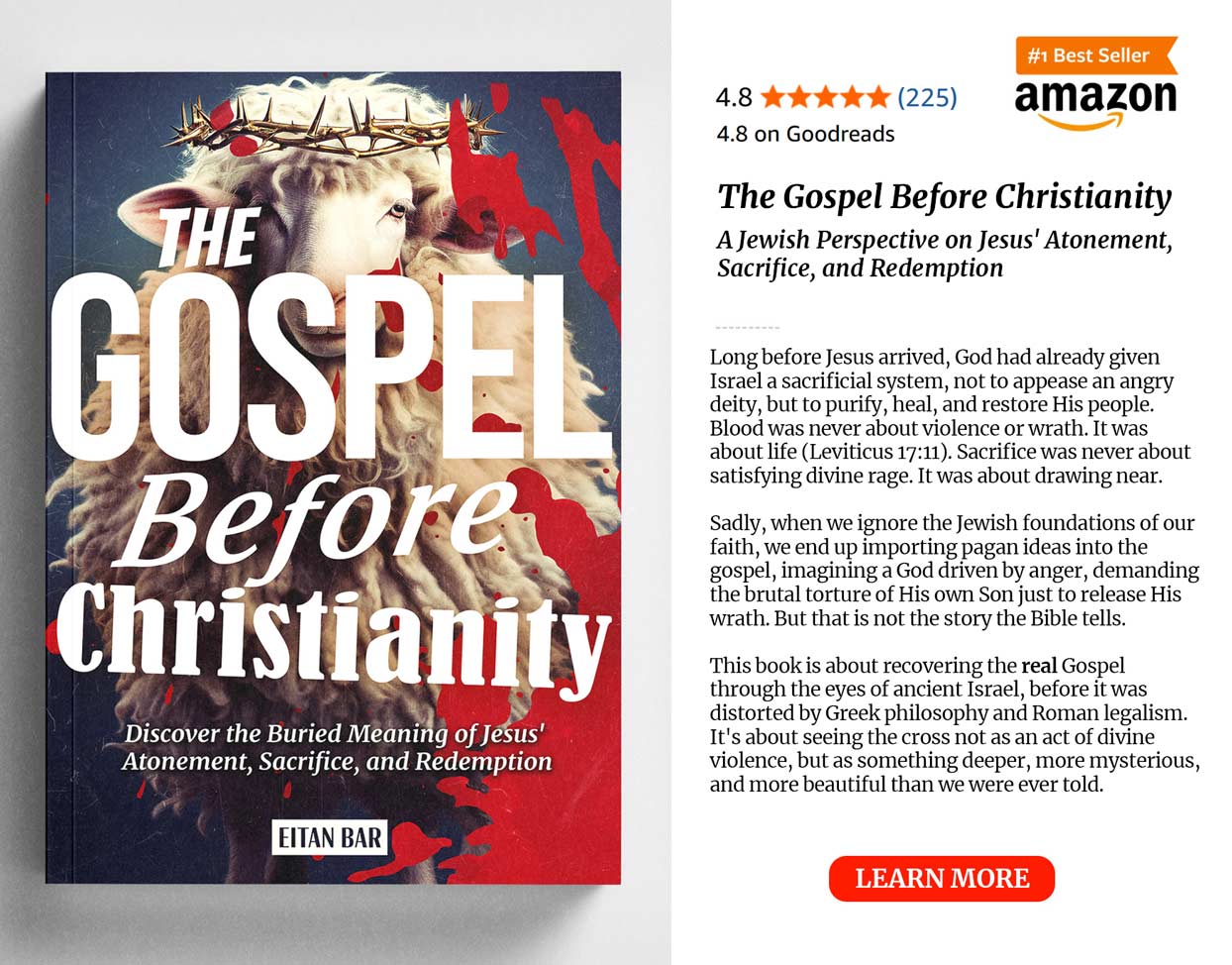
This was an excerpt from my upcoming book, The Gospel Before Christianity: A Jewish Perspective on Jesus’ Atonement, Sacrifice, and Redemption. Available for pre-order at a special price on Amazon: